This post is a snapshot from its publication date and is no longer checked for accuracy. For the current picture, see our actively maintained guides.
Bulgaria's economy is among the most dynamic in the EU at the moment. In the second quarter of 2025 it recorded a strong increase, placing it near the top of the European table. That is not an isolated result: it fits a pattern in which many eastern European countries post higher growth rates than the western European economies. Below we look at Bulgaria's recent figures, set them against Germany's, and place the growth in the wider trend.
The numbers
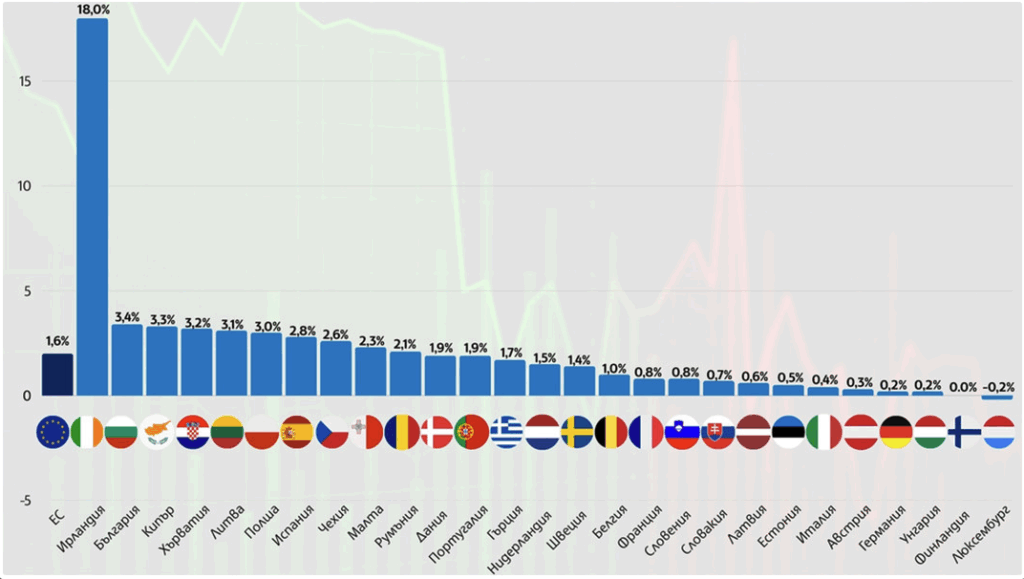
In the second quarter of 2025 Bulgaria's gross domestic product grew by 0.9 % quarter on quarter and 3.4 % year on year. That was the EU's second-highest annual growth rate after Ireland. For comparison, the EU average over the same period was around 1.6 %. The first quarter of 2025 pointed the same way, with growth of a robust 3.1 % year on year.
Annual GDP growth of EU member states, Q2 2025 (%). Bulgaria's 3.4 % was the second-highest in the EU. Source: BNR
Over a longer horizon the picture is similar. After the pandemic contraction in 2020, Bulgaria's economy recovered and now outpaces much of western Europe. In 2023 Bulgarian GDP grew by roughly 1.7 % despite difficult global conditions, and international institutions expected around 3 % for 2024. Between April and June 2025 the economy reached a volume of about €27.6 billion — growth in absolute size, not only in percentages.
Faster than Germany's
The figures from Sofia contrast sharply with those from Berlin. Germany's economy has been struggling with stagnation for several quarters. For the full year 2023 German GDP fell by 0.3 % — the only large European economy to contract. 2024 stayed tense, with leading indicators pointing at best to zero growth. The latest quarterly figures confirm the weakness: German GDP shrank by 0.1 % in Q2 2025 against the previous quarter, with broad stagnation year on year.
The contrast reflects a wider trend. For several years now many central and eastern European member states have grown faster than their western partners, driven by catch-up effects, investment and strong domestic demand. Poland remains a regional engine, with GDP growth of around 3.3 % forecast for 2025 — roughly three times the European average. Researchers have expected the eastern EU states to expand by around 2.5 % on average against the euro area's 0.8 %.
What is enabling it
Conditions have favoured this growth in countries like Bulgaria and Poland: falling inflation, sharply rising real wages and strengthening private consumption. People spend the additional income, which feeds back into the economy.
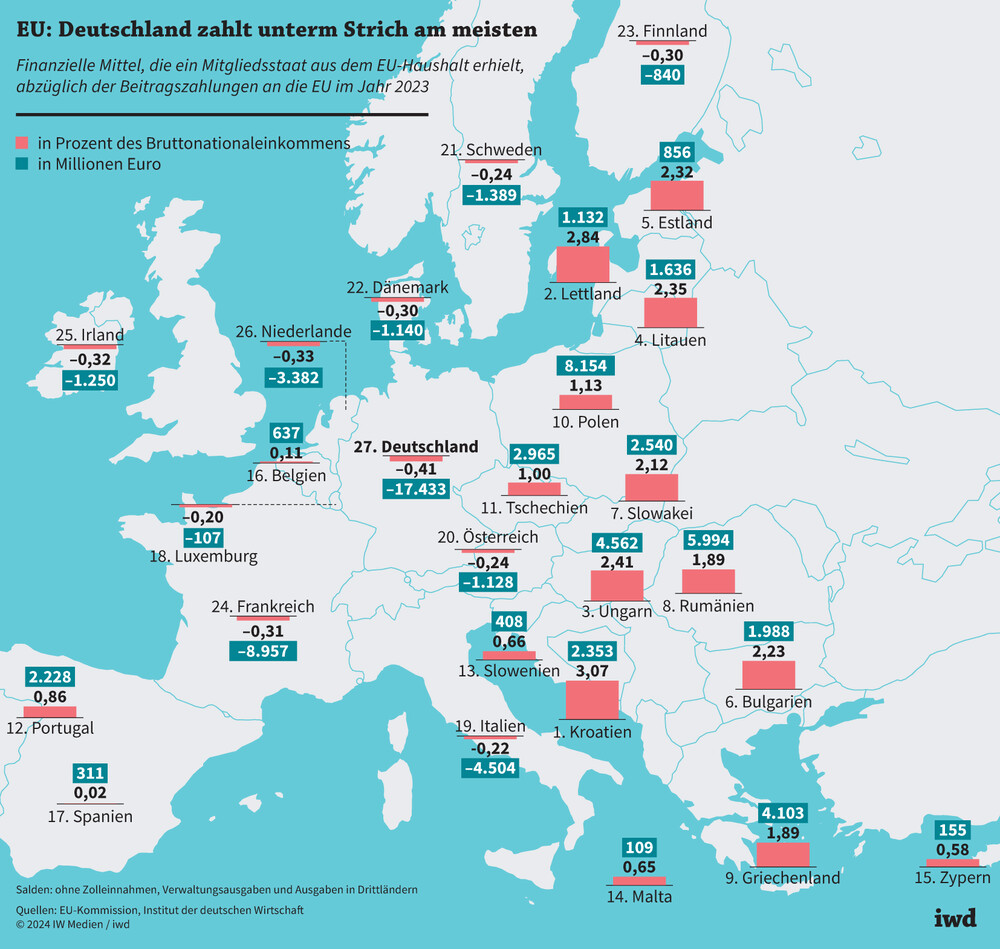
EU funds also flow into infrastructure and modernisation, and eastern member states benefit disproportionately. In western Europe, high energy prices, skills shortages and weaker industrial demand weigh on output; Germany in particular still feels the after-effects of the energy crisis and the inflation that followed.
Funds received from the EU budget minus contributions paid, by member state, 2023. Source: IWD
What this does and does not tell you
Bulgaria currently stands out in Europe, and if the trajectory holds it will keep posting above-average gains alongside countries like Poland — a sign of continuing economic convergence within Europe.
Two cautions are worth stating plainly. Growth from a lower base is easier than growth from a high one; converging on the EU average is not the same as reaching it. And a strong national growth rate says nothing directly about whether a particular business will do well here. It is context for a decision, not a reason for one. The concrete questions — costs, taxes, who does the formation — are covered in our guide to starting a business and the provider comparison.
Bosch is closing its engineering center in Sofia while Liebherr builds for Airbus near Plovdiv. What this really says about German investment in Bulgaria.
Shelly makes smart-home devices in Sofia and sells them in more than 100 countries. Schneider Electric has proposed to buy it for about €1.2 billion. A look at what Shelly does, the path from the Bulgarian Stock Exchange via Frankfurt to the SDAX, what Schneider would pay, and what Bulgarian founders can learn.
Bulgaria's renewed JEREMIE programme is expected to mobilise about €210 million for high tech and scale-ups. What is confirmed, what remains unknown and what DACH investors and founders should examine.