How long does it currently take to register a company in Bulgaria? In law, the answer looks remarkably simple: an application for the initial registration of a trader should be examined by the end of the next working day after filing. In practice, 2026 exposed a much messier reality. Bulgaria's Registry Agency entered the year with a large legacy queue of annual financial statements, only around half of its approved registration officers were actually working at one point, incoming applications surged, and euro-related company changes added another layer of work.
That does not mean every new EOOD or OOD now takes weeks. It means founders should stop treating one number — whether "next working day", "1–3 days" or "two weeks" — as if it described the whole formation process. This article separates the legal deadline, observed register delays, the total incorporation timeline and bank onboarding.
The Commercial Register and Register of Non-Profit Legal Entities is Bulgaria's central electronic register for companies and other registered entities. It is administered by the Registry Agency under the Ministry of Justice. The system replaced the old court-based company-registration model with a central electronic database designed to make company information and filings publicly accessible.
For an ordinary company founder, the register is where the company becomes visible as a registered legal entity. It records and publishes, among other things, the company name and seat, managers and representation, capital and changes to registered circumstances, and documents that the law requires to be published. It also receives annual financial statements and certain declarations.
The public Registry Agency portal lets you search existing companies, check names, inspect published filings and submit applications. Once a company is registered it receives its EIK/UIC, the unified identification code used across official interactions.
The register is only one part of forming a company. It does not replace the notary step where required, the capital-deposit account for an EOOD/OOD, VAT analysis, accounting setup or the later operational business-bank account. Our formation guide shows the sequence; the remote-formation guide explains what changes if you do not come to Bulgaria.
What the law says about processing time
Article 19(3) of Bulgaria's Commercial Register Act says that applications for the initial registration of traders are to be examined by the end of the next working day after receipt by the Registry Agency. That is the statutory processing rule — not a guarantee that every real-world formation is operational the next day.
A correct filing can still depend on documents, notarisation, bank certificates and whether the Registry Agency issues instructions or refuses an application. And after registration, foreign-owned companies can spend materially longer on banking and compliance. If you want to budget the full first year rather than only the filing fee, see what a Bulgarian company really costs and our formation-cost guide.
What went wrong in 2026?
The Registry Agency's own July 2026 explanation is unusually specific. As of 21 May, applications were being processed with an average delay of around four working days. That figure covered the Agency's workload generally; it should not be misread as a measured four-day waiting time for every new company registration.
The Agency identified several pressures at the same time:
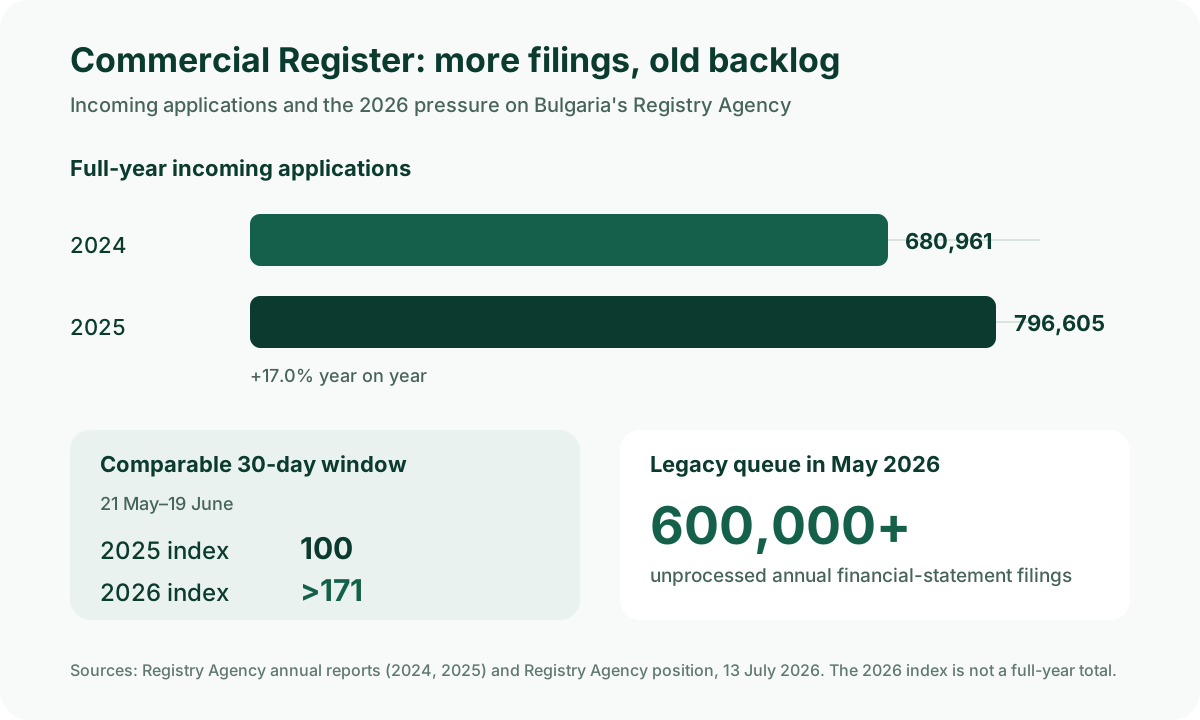
A legacy queue of more than 600,000 annual-financial-statement filings. These were not all new 2026 filings. The Agency described them as accumulated from earlier periods.
Limited effective staffing. The approved headcount was 119 registration officers, but around 60 were actually working at the point described by the Agency, with vacancies and absences reducing capacity.
Manual work. A large part of the older financial-statement material had been submitted as scanned documents and required checks against company files and other systems. The Agency explicitly pointed to insufficient automation and integration.
A sharp increase in incoming applications. Comparing 21 May–19 June 2026 with the same period in 2025, incoming applications rose by more than 71%, while productivity rose by 47%.
The euro transition added company-file activity. Registered companies had to deal with capital conversion and corresponding register changes, creating another burst of filings.
In other words, the problem was not simply "slow clerks". It was a queueing problem: an old stock of publication filings, labour-intensive review, too little effective capacity and a new wave of company changes arriving at the same time.
Application pressure was already rising before the 2026 bottleneck. Full-year incoming applications increased from 680,961 in 2024 to 796,605 in 2025. In the comparable 21 May–19 June window, 2026 applications were more than 71% above 2025. Sources: Registry Agency annual reports and the Agency's 13 July 2026 position. The two panels are different measures and should not be compared as if both were annual totals.
The backlog itself is older than 2026
Parliamentary and Justice Ministry records show that the annual-financial-statement queue had been accumulating for years. Historical official reporting recorded very large stocks of unprocessed statements well before the 2026 spike. In 2024 the Agency was still able to process most ordinary registration applications quickly, even while staff were working overtime to reduce the publication backlog.
What changed in 2026 was the combination of that old queue with much higher incoming volumes and euro-related changes. Parliamentary discussions in the summer described delays for changes to existing registrations reaching around 20 days and projected much longer waits later in the year if nothing changed. Those projections are useful evidence of system pressure, but they are not current waiting-time statistics for new company registrations.
What changed on 6 October 2026
Parliament's answer was structural: stop annual financial statements from blocking the ordinary registration queue. The amendment was published in State Gazette No. 92 of 6 October 2026 and entered into force on publication.
„с изключение на заявленията за обявяване на годишните финансови отчети и доклади“
State Gazette No. 92, 6 October 2026, §1
Our English translation: “with the exception of applications for publication of annual financial statements and reports.” In practical terms, the law now allows those publication applications to be handled separately from ordinary registration work rather than holding the same place in the processing sequence.
The amendment also created a route for up to 30 additional temporary registration officers for fixed-term appointments. On 19 October the Registry Agency announced that the technical separation had been implemented following an executive order of 12 October and that recruitment for those temporary positions was under way.
This is a sensible queue-separation measure. It is not evidence that every backlog disappeared overnight.
So what is the current waiting time?
As of 29 October 2026, we have not found a published official post-reform median for new EOOD/OOD registrations. The statutory rule remains next-working-day examination for initial registrations, but the available official material does not yet show whether that service level is being met consistently after the October change.
Comment requested from the Registry Agency — 29 October 2026. Start in BG has contacted Bulgaria's Registry Agency directly and asked for its current average or median processing time for complete EOOD/OOD incorporation applications, whether initial registrations differ from changes to existing companies, whether the October separation of annual-financial-statement filings has measurably reduced ordinary processing times, the current backlog and 2026 application volume, and the status of the additional temporary registration officers. No response had been received at the time of this update. We will add any attributable official answer and linked statistics here.
That uncertainty matters. A founder should not convert the statutory deadline into a promise to a customer, investor or bank before the registration has actually appeared in the register.
Our own 2025 formation: fast personal steps, later registration
Our own experience is useful precisely because it shows why formation time and register time are not the same thing. When we formed Berlin Sofia Partners in 2025, our essential personal steps in Sofia — notary, bank and document handover — fitted into one day. The formal registration was confirmed roughly one to two weeks later, as I remember it.
We therefore never use our "one day" story to claim that the company itself was registered in one day. You can read the full reconstruction in our Berlin Sofia Partners formation story.
That historical case is also not a current benchmark for 2026. It is one founder experience from before the present backlog and before the October reform.
How founders should plan now
Separate the four clocks. Document/notary preparation, Registry Agency processing, total incorporation time and operational banking are different timelines.
Do not build a launch date around the legal minimum. The next-working-day rule is a legal processing standard, not a project-plan guarantee.
File clean documents. A missing declaration, name issue or correction instruction can matter more to your own timeline than the average queue.
Ask your provider for observed current timings. If you use a formation firm, ask specifically for its last several completed EOOD/OOD registrations, not a marketing-page promise. You can compare disclosed provider scope in our provider register.
Plan banking separately. For a foreign owner, bank KYC can still be the longer and less predictable part of becoming operational.
If you are forming remotely, add document logistics. Notary, apostille, translation and courier time can dominate the calendar; see our remote-formation guide.
For the broader practical process — formation, tax, banking and operating a Bulgarian company — our book “Start in Bulgaria” brings the pieces together.
Verified 29 October 2026. Primary sources used: Bulgaria's Registry Agency, the Commercial Register Act published by the Ministry of Justice, State Gazette No. 92/2026 and parliamentary records. Processing times are operational facts that can change quickly. We will update this article when the Registry Agency publishes post-reform performance data or provides an attributable response to our comment request.
Our real Berlin Sofia Partners formation journey: why we chose an OOD, how the notary, bank and Commercial Register steps worked, what it cost, and what we would repeat.
Dozens of providers, prices from €89 to well over €1,700, and marketing that promises guarantees no one can give. The four provider types, the red flags to watch for, and ten questions to ask before you sign. Final part of our formation series.
Almost every provider advertises remote formation – and for the registration it is largely true. But power of attorney, apostille, capital account and above all the bank draw the real line. What works from abroad, what doesn't, and when one flight beats it all. Part 4 of our formation series.